
Face to Face With Everything
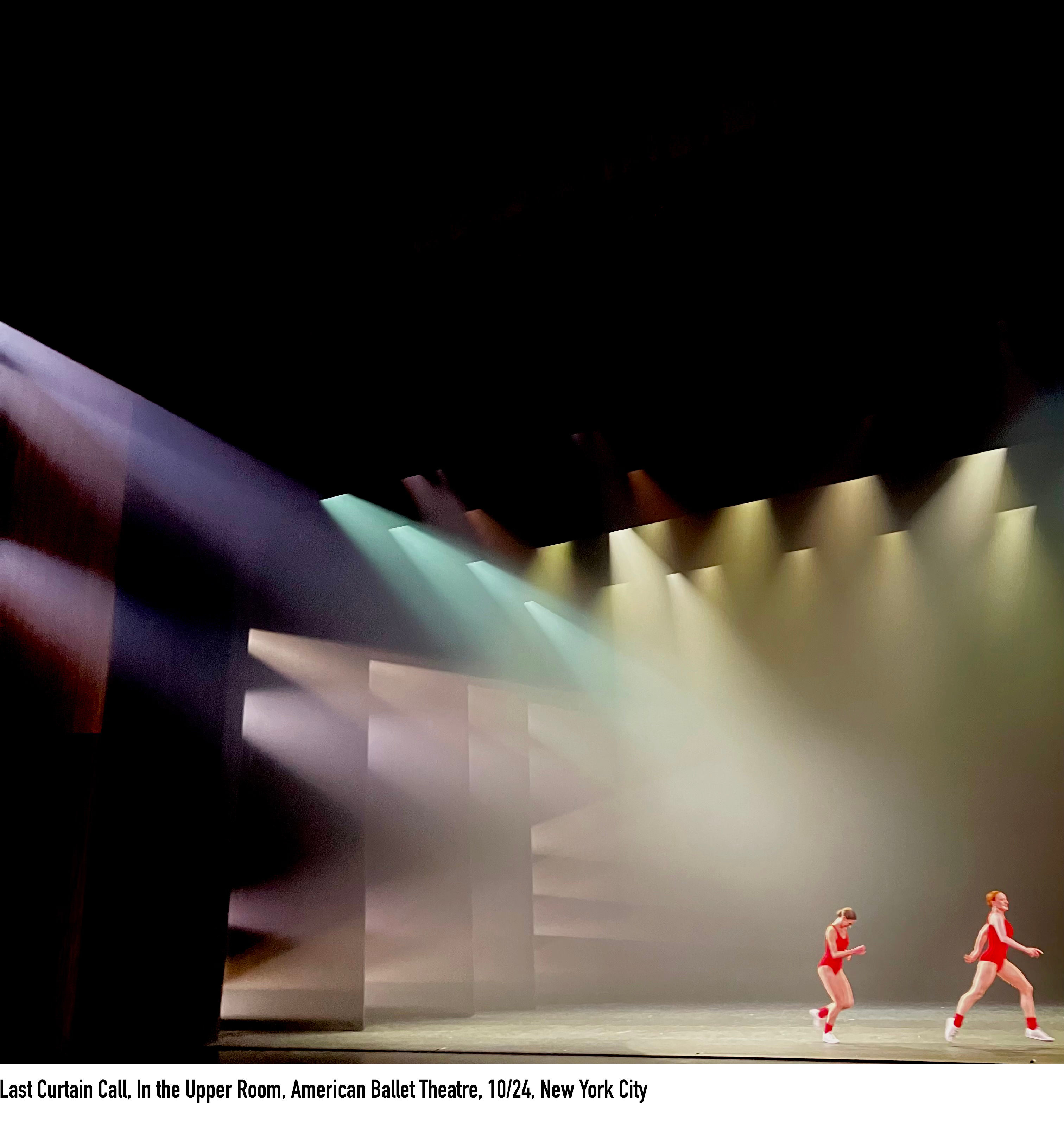
Notes on In The Upper Room, as performed by the American Ballet Theatre, October, 2024

Oh hey there! And Happy New Year. Here is a description of the very best thing I saw last year. (Also my first post with Substack.) Here is me sharing with you something that taught me something about facing all the worlds to come and dancing to the music of time. / “Have nothing … which you do not know to be useful or believe to be beautiful,” said the sainted polymath writer and designer William Morris in 1880. This communiqué, “or believe to be beautiful”, is a way for me to share with you work that isn’t necessarily the straight design writing and architecture criticism that you can find from me in such places as The New York Review of Architecture, n+1 and The New Yorker——from my training as an architect and my experience as a professor of architectural design. These notes are from the heart, and so not necessarily from the areas of my expertise——but glimpses of the world that I aspire to face with you together. / Design is how to see the world and design thinking is how to change the world. To make ourselves useful and our world beautiful. This is about that. / Thank You for being among the community to which I send this out. I’m starting it small in the hopes that you will share it and pass it along to the folks you feel might love to discover it——and we can together grow the conversation and the communion. Share. Restack. Copy and Paste. See what you think. See how you feel. See you soon. Tell me what you’d like to hear about from me, here. Tell your Friends. Like and Subscribe. Know to be Useful. Believe to be Beautiful. //
i / alive
“In the Upper Room,” sounds like what you’d say about where someone is, who has gone to Heaven. If you didn’t quite want to say it. If you didn't want to to know with your tongue—and therefore also with that other miracle muscle, your heart—that they were gone. They’re just upstairs. There’s the room above—and all the attics of your mind, all the holies of holies. In the words of America’s greatest spiritual: if I get up there before you do, I’ll open up a trapdoor and pull you on through. Biblically, the phrase refers to the Cenacle, the chamber where the Last Supper was eaten. But then there's the room below, there’s the basement, there’s the old rag and bone shop down the ladder, there’s the pit of the stomach, there’s three o’clock in the morning—or the name they give Hell in folklore, when they don’t want to call the devil by his name and address: The Other Place. But what the upper room shows us, through Twyla Tharp and Philip Glass and Shelley Washington and Norma Kamali and Jennifer Tipton, and all its hidden musicians and its singular singer—and above all through the dancers of the American Ballet Theatre who make their courageous way, one step and leap and fall at a time, through each one of its 39 minutes—is not a prophecy of the world to come, nor a glimpse behind the veil, behind the great golden curtain. It faces us only with how good and how hard it is, for alas precisely one lifetime, to be alive.
ii / light
There is something about being face to face with everything. About trying not to look away from the one before you—even if that one is merely a double and a shadow and a twin, in imperfect symmetry: you yourself. The dance starts. A burst of white light. Two dancers. In white high-top Reeboks. Already at the front of the stage. As if they were just born. Or else as if like the titans of old they had never been born but had been exactly there since the beginning of time. This, to borrow and break a word from the ballet, is their first position. They stand close together. Shoulder to shoulder. They address us. They look out. They seem to look into each of our eyes. Imagine, though, their own view as they look out toward us: that blinding white light is a spectacle for the benefit of the audience, it is not made to guide their way. They must face, out into the theatre that is also mostly a high and empty room—as if prone and facing up into a night sky on a bad night—a great darkness. They must enter, so often, not from the sideways safety of the wings, but from upstage, running right at us, borne through some invisible curtain, out of that other darkness behind them, toward the darkness of the house. Therefore out of darkness and into darkness, through light. They come at us as if we are the dark water and they are running into the ocean to save our lives. Imagine these dancers’ radical courage: speeding full force towards the lip at the front of the stage, to the very edge of the known, trusting in their own bodies to swerve and in a band of angels to carry them. Over and over again.
iii / swing
There is something about undoing. This is not the undoing of what you have already done. There is no such undoing. Even dancers, running backwards, retracing their steps, are yet moving forwards through the choreography, the acts, the hours. Not even dancers escape the jurisdiction of the Fates—from ancient Greek their names translate into the Spinner who weaves the fabric of life, the Measurer, who suits it to us, and the Unbending, she who cuts off the thread of our life at the moment of her choosing. But there is another kind of undoing-even-while-you-are-doing. It is a kind of looseness, a kind of sway, a kind of elasticity that contains, within every movement, an acknowledgement of its opposite. The silky ripple of the striped jumpsuit. “Do I contradict myself? Very well then, I contradict myself.” I’m told this is Twyla Tharp. It’s a swing to the hips. It’s moving your arms as if your fists are very heavy—the boxer with the gloves just back again on their fists over their bound hands, taking their weights and measures as if for the first time. As if the centripetal movement of your own hands is what’s swinging you around. It’s sidewinding Popeye, feet splayed out and wrists tucked in, knuckles against the sides of the belly, in an old black and white cartoon. It’s Charlie Chaplain. It’s Buster Keaton. It’s John Keats’ negative capability. I read in the program this piece came out of 1986: was Tharp’s radical motion—there between the Cold War-era promise of death from the sky, and the AIDS-era falsehood that death came from our own loving bodies—the only wiggle room to be found? There is a 1973 movie called The Long Goodbye—another way of saying dying—in which the actor Elliot Gould plays the famous Raymond Chandler detective Philip Marlow. Humphrey Bogart, all street-smart gentility and reluctant cruelty, made this role famous in 1946 in the film noir The Big Sleep—another name for death. So Gould plays Marlow. But he also plays Bogart playing Marlow. And he also plays Gould playing Bogart playing Marlow. Yet he also—at the edge of the known world, at the lip of the stage—plays an unnamed soul playing someone who was born into a name and a body and a time and a place and so had to become Elliot Gould, then playing Bogart playing Marlow. Life in performance. One in a thousand people can do this. One in a hundred actors can do this. Every single one of the nine ABT dancers in the Upper Room can do this. “Down these mean streets,” Raymond Chandler wrote of Marlow, “a man must go who is not himself mean. He is everything.” This undoing capacity must be found in the body because it is impossible—almost—to achieve with mere words. It is not coy. It is not satiric. It is not ironic. It is not disavowal. It is not a refusal to go on.
iv / years
This was some years earlier. I was a present guest of an absent guest. I was a friend of a friend of her son. My friend had taken up the invitation to use the seat that she had bought next to hers, almost a year before, for that now absent son. An estrangement, not explained. A distance across an ocean. My friend had at the last minute discovered somewhere else to be. He politely sang my praises. Now, over French fries and drinking red wine, taken fast, at intermission, she was telling me about her son. I could see her at 80, 60, 40, 20. That was a new experience. I was myself, I knew then, and I was also the son. I did not refuse to go on. But—Popeye—I moved just enough the other way, to stay myself. We were halfway through. It had already been a long time. That far in, and with that far to go, just the sound of spoken language was astonishing. A Philip Glass performance, with his old band from 1975, including the early and enduring work, the work that was work of endurance: Music in Twelve Parts. And more parts after that. Hours and hours. And hours. There was man himself, working away at a small electric Hammond organ in the darkness, like a knife grinder over a whetstone raising sparks, like a stone-faced Roma puppeteer making some Commedia del Arte on the Ramblas. Here are things Philip Glass did before he became famous: He worked for a moving company run by his cousin, carrying refrigerators up and around the stairs of fourth floor walk ups. The great ascent. He was a studio assistant for the artist Richard Serra, whose architectural sculptures in steel are so heavy that the floors of galleries have to be reinforced to bear them. He was a plumber. A cab driver. Through the binoculars: His big hands like a bear’s paws. Like a boxer’s taped hands. The muscular forearms of Philip Glass, woven through with veins and tendons, like Popeye’s forearms, lifted heavy yet weightless above the keys.
v / architecture
Her arms and her shoulders and her arms and her shoulders and her arms and her shoulders. The human architecture of the supraspinatus across the shoulder; the acromion pinnacle at the shoulder’s very tip; the deltoid; the triceps; below the elbow the brachioradialis of the forearm; that swell—Popeye’s maximum—before the last taper toward the impossibly narrow wrists. The brachioradialis where the hand of one dancer finds the body of her neighbor, for lateral and cross-brace support. The line of beauty: all across and across and across and along and along and along those shoulders and those arms. Like waves in a long set before a break. Above all—when all is holding, when all is strong, when all is up in the air: the deep declension, the valley between the deltoid and the triceps, a third of the way down the upper arm, six times over. Somewhere in part five of The Upper Room, the Great Ascent truly begins. In the music. In the muscle. Three women are lifted aloft by three men. They are two and two and two and they are three and three and they are six. Through the binoculars: the dancer on stage right, house left—her right arm stretched taut toward the wings of the stage, out and out and out to her very fingertips. As if the air, too, had its long fingers across her brachioradialis, and her fingertips across the air, supported and supporting. She smiles, only for a heartbeat: is it the slightest irritation that the man below her has overshot the mark, lifting her higher than all the rest? Is it the pleasure of being the Winged Victory of Samothrace?
vi / tired
There are two ways of thinking about time. There is instance and there is continuance. Are instance, Instantiation, instancy like particles of light? Like the click of the camera? Are continuance, continuation, constancy like the waves? Like sweep of the second hand? In the instance, there is only now. There are only her arms and her shoulders and her arms and her shoulders and her arms and her shoulders. Only that line of beauty, three wingspans wide. Taut between the wings of the stage itself. The women above the men. The women steadied by one another, fingers to forearms. There is only the very moment that the Winged Victory Of Samothrace, the bowsprit of the ship, breaks the waves. And yet, there behind is the long wake of the ship, bright against the dark waves, back to the horizon: continuance. In the continuance, there is only forever. One thing after another. Sit in the audience and follow with your eyes just one dancer, all through part six of In The Upper Room. Become tired with her. But never of her. Feel the shake inside the arm that is trained not to shake. The hand outstretched, the forearm, by part six, now as heavy as the Popeye forearm of Philip Glass, forever suspended over the keys. One step. The next step. A cross-stitch. An embroidery. A sampler. Life at the needlepoint, trailing the thread. The woman moves through the labyrinth. And yet the labyrinth is itself made of men and women in constant motion, each of them in another labyrinth made of women and men in constant motion. Each one Theseus and Minotaur and Ariadne, all across time, all at the same time.
vii / Reeboks
There is something about finality without conclusivity. Finally, one dancer and another are cheek to cheek, palm to chest! But that is never their last step, is it? There is the ever after, too… There is one thing after another. There is something about confluence without coordination. The match is never perfect, is it? There is something about transference: do three shirtless men each make the same gesture in their own way, or does the one gesture make three shirtless men move three ways? At some point—not in part seven but in some complement to it somewhere in the continuance of all the piece—two women pause in mutual consultation and conspiracy, both in white high-top Reeboks. They are the women of beginnings and endings. They stand together, downstage, near us. Behind them, three other women in more customary skirts, red pointe shoes, ribbons, pass distantly, far upstage: as if out of memory, out of reach, out of tradition, out of Degas. The two women in the Reeboks are dressed half for the stage, and half for the rest of the world that is not a stage. They are between the upper room and the lower room. They show that such a state is possible. And it is their feet, the dancer’s essential tools, that are ready not for the stage but for the world, that are shod not to pirouette but to walk down these mean streets.
viii / ready
In the end we will leave before we are ready. We will have practiced leaving by not really leaving because it was only intermission and there was the promise of return. We will fall back down, out of the smoke, into our bodies. We will stand, we will turn, we will walk so slowly, we will ascend the aisle, raked like the stage itself, now in this other light that is not the light from the stage. We will think: there is the stage and there is the rest. We will think: everywhere is the stage and we are all dancers. We will think: everywhere is the rest and we are none of us dancers. Do I undo our weaving if I tell you that what I am certain I shall remember forever from that night was not on the stage but only in my peripheral vision, almost a blur: someone in the crowd—by her long neck and the tight bun at the crown of her head, surely a dancer or once a dancer. She moved to no music but the pulsing alarm signaling the end of intermission. She was diligent about her return. She ran. Splayfooted as Popeye. But her back and neck, the z-axis, were straight straight straight. Straight to heaven. Straight to the upper room. Her arms and shoulders glided at constant elevation. As steady if she were standing still. Yet she moved. And fast. I thought: this, this right here, this must be the Art. I thought: within each one of us, there is an upper room and a lower room. The seven chakras—three below and three above and one above all. The old non-quite-joke about the swan moving on the English river: all effortless above the waterline, all effort below. The hidden work in the lower room, in the pit of the stomach, in the gut: the rehearsal, over and over and over and over, the getting the story straight, the anticipation and the recollection, the construction of the musculature and the muscle memory, the counting and the recounting, the injury and recovery, the before and the after. And then all the lifetime after.
ix / together
There is something about coming together and coming apart. In this choreography, the greatest intimacy seems to be not in proximity: the man lifts the women but at those flying trapeze moments the woman seem mostly to have her back to the man: she faces away from him. Or else you could say that they two together face the same way. He, behind her as usual, tries to see just what it is that she sees. That she rises up to see. At the moment of lifting, the body of the woman flexes: light as a feather, stiff as a board. This must be a matter of technique, the stiffer body stronger in cantilever. Safer to handle. And yet it reads—almost—as a flinch. Or else as that constant simultaneous undoing of the doing: yes you shall hold me but I shall not be held. I will be consoled but I will not be consoled. Instead, the greatest intimacy seems to be across distance. A direct message across an ocean: dusk calling dawn. Across the ocean of the whole stage, left to right. Imagine the radical spatial awareness of the pair of dancers who, running backwards in their white high-top Reeboks, inscribe upon the stage two halves of a great circle. They begin shoulder to shoulder, as at the very beginning of the piece, then recede. Imagine their peripheral vision. Imagine the muscles that move their eyes, that as they transect the spotlights, open and close their irises. Between them there is the impossibility of perfect symmetry. Between them there is the possibility of imperfect symmetry. Five women and four men: always someone left out. The two women trace these double arcs once, then twice. And in the end for a third time. And then they have almost found one another again toward the lip of the stage and the abyss beyond. And then there is an ending of the kind that offers all the paradise there may be for us unbelievers, all the eternity there may be for us mortals, as those two women barely begin their circle for the third time and so begin to find their first position—which is to say an ending of such suddenness unforeseen that its seems to be no end at all. //